


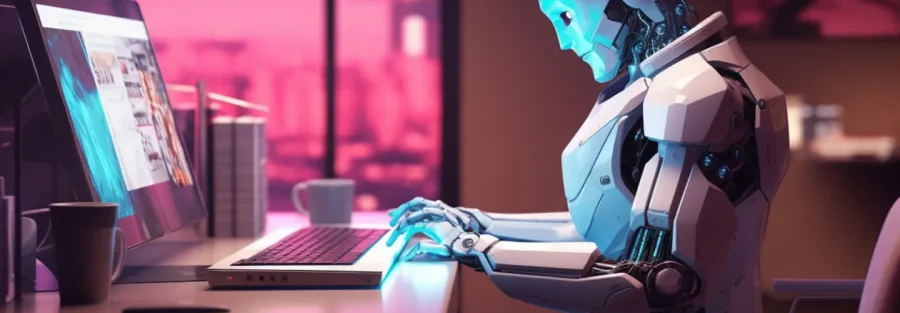
Despite all its capability, AI still struggles with parts of office life that humans barely think about. These are not always technical tasks or complex calculations. In fact, many of them are ordinary, awkward, emotional, or deeply human moments that keep workplaces functioning beyond spreadsheets and deadlines.
And strangely enough, those moments may be more important than businesses realize.
AI Cannot Set Up a Laptop
AI may process calculations, but it cannot deal with the frustration of software refusing to install correctly. Humans still perform these practical tasks that require physical interaction with the real world.
This limitation matters because office work is not entirely digital. Behind every automated process exists a physical environment filled with machines, networks, desks, damaged chargers, forgotten passwords, and unexpected technical problems that require human patience and adaptability.
AI Cannot eat Chips with Coworkers
There is a reason office culture often forms around coffee machines, lunch tables, and snack breaks rather than conference rooms. Some of the strongest workplace relationships are built during completely unproductive moments.
Coworkers complain about deadlines while eating chips. Someone shares a strange story from the weekend. Another person laughs too loudly at something that barely deserves a reaction. None of this appears important on paper, yet these interactions quietly create trust between people who later need to collaborate under pressure.
AI cannot participate in this naturally. Maybe part of it is because AI doesn’t even want to. Is there a diet or something in the image here? Weird.
AI Cannot Truly Create Original Vision
There is a growing assumption that AI can now create almost anything. It writes articles, generates images, builds presentations, and even assists with coding. Because of this, many people have started believing that AI can independently create the future itself.
Yet there is still an important distinction between generating and originating.
AI learns from existing patterns. It reorganizes information that already exists and produces outputs based on data it has consumed. Humans, on the other hand, often create ideas from instinct, imagination, frustration, ambition, or emotion.
AI Cannot Beat True Experts in Newsletters
One of the most fascinating things about AI is that it can write extremely quickly. It can produce reports, newsletters, summaries, and marketing copy within seconds. Yet speed does not always equal depth.
Great writing is rarely about information alone. It is about rhythm, emotion, tension, humor, timing, and understanding what makes people feel connected to words. A powerful article often works because the writer understands human reactions beyond grammar or structure.
For example, true experts know when to slow a sentence down for dramatic effect. They know when something feels too cold, too robotic, or too predictable. They understand cultural references, emotional nuance, sarcasm, and the strange energy behind storytelling that keeps readers engaged.
AI can imitate these qualities impressively well, but imitation still differs from lived human perspective.
AI Cannot act in Charades when coworkers play
One of the biggest differences between humans and AI appears during game time.
AI performs exceptionally well when systems are stable and data is available. However, offices are often chaotic places, especially when the game days are on. But if you are on a team with AI, you are on a losing team. AI just doesn’t know how to act in charades, or what letters to give in word hunts.
AI is the worst player you can have by your side on game days.
The Future May Not Be Humans vs AI After All
The conversation surrounding AI often becomes dramatic very quickly. Some people believe machines will replace entire workforces, while others insist human roles are completely safe. The truth, however, may exist somewhere between those extremes.
AI is extraordinarily useful for repetitive processes, analysis, organization, and automation. It removes inefficiencies that previously slowed businesses down. However, the deeper human layer of office life — relationships, intuition, leadership, creativity, trust, humor, and emotional intelligence — still belongs largely to people.