

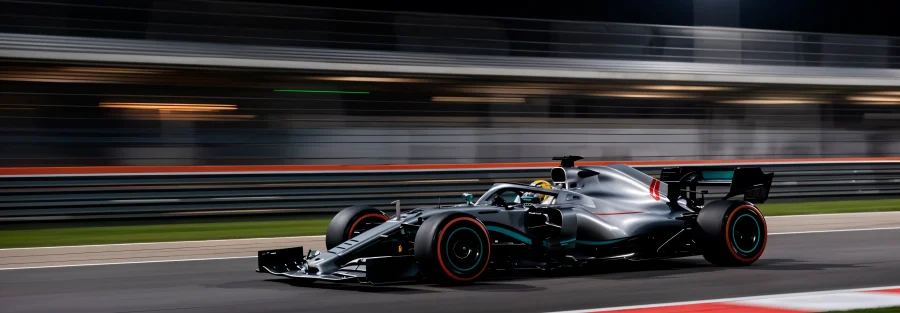
For Bahrain, Formula One is a statement. When the first Grand Prix was held on 4 April 2004, it was a signal. A small island kingdom of fewer than two million people was announcing itself to the world through the most globally watched annual motorsport series.
Twenty-one years of races later, Bahrain still holds that Grand Prix. The human rights situation, by the measurement of every independent index that tracks such things, is measurably worse than it was in 2004. The race contract runs until 2036. Both of these facts are treated, by the relevant parties, as entirely compatible.
Let’s take a look at all these years – Vroom, here we go…
2004 — The Beginning
The first Bahrain Grand Prix was awarded the FIA prize for Best Organised Grand Prix. This was accurate. The circuit was modern, the logistics were flawless, and the hospitality was the kind that makes senior motorsport officials feel that a country is serious about its international ambitions. The race was also, from the beginning, something more than a sporting event. It was an argument: that Bahrain was open, global, welcoming, modern, a place where the world’s fastest machines and the world’s wealthiest sponsors felt comfortable.
This argument has been made, with impressive consistency, every year since. The race has never been cancelled for human rights reasons. Russia lost its Grand Prix in 2022, after the invasion of Ukraine. Bahrain has never been Russia. The year the first race was held, Bahrain ranked somewhere in the middle of the global press freedom index. By 2024, it ranked 173rd out of 180. The descent was not sudden. It was steady, measurable, and occurred entirely within the years the Grand Prix was taking place.
What the race programme said, every year
The official narrative of the Bahrain Grand Prix has remained remarkably stable across twenty-one years. It is a celebration of speed, technology, and national ambition. It brings investment. It creates jobs. It puts Bahrain on screens in every timezone. The race programme, every year, opens with a welcome from officials. The officials change. The welcome does not.
2011 to 2022 — The Record
In February 2011, Bahrain’s pro-democracy movement took to the streets. The government’s response was sufficiently forceful that the 2011 Grand Prix, scheduled for March, was postponed. This was the closest Formula One came to cancellation in Bahrain. It was rescheduled for October of the same year. By that point, the crackdown had been described by human rights organisations as one of the most severe in the Gulf. Doctors who had treated injured protesters were arrested, tried before military tribunals, and sentenced to prison. The race went ahead.
2021 to Present — Still Running
Dr Abduljalil Al-Singace is an academic, a blogger, and a human rights defender. He has been in prison since 2011, serving a life sentence for his role in the pro-democracy protests. During his imprisonment, he wrote a manuscript. The manuscript was a work of academic research. In 2021, prison authorities confiscated it. In protest, Dr Al-Singace began a solid-food hunger strike. By April 2024, the hunger strike had passed one thousand days. He was still in prison. The manuscript had not been returned.
The Grand Prix that year was held in March. It was attended, as it is every year, by drivers, sponsors, celebrities, and the international press corps that covers the sport rather than the country. The 2024 race was celebrated as the twentieth anniversary of Formula One in Bahrain. State media described it as twenty years of glory.
Results: 2004 – 2025
| Metric | 2004 | 2025 |
| Press Freedom Ranking (Reporters Without Borders) | Mid-table | 173 / 180 |
| Independent Newspapers | 1 (Al-Wasat) | 0 |
| Estimated Political Prisoners | Few | 320+ |
| Human Freedom Index | Above bottom | One of the largest recorded global declines |
| F1 Contract | First race | Extended to 2036 |
Note: This scorecard does not appear in the race programme. It is produced, every year, by the organisations that track such things, and sent to Formula One’s leadership, and acknowledged in carefully worded responses that note the importance of engagement and dialogue and the sport’s role as a platform for positive change. The positive change, by the measurements available, has not occurred. The dialogue continues. The race continues. The scorecard accumulates another row.
The Final Lap
The Bahrain Grand Prix is not, in itself, the cause of Bahrain’s human rights situation. The situation predates the race. It would exist without the race. The drivers who race in Bahrain are not personally responsible for the policies of the government that hosts them. The sponsors are not designing the prison conditions. The mechanics are there to change tyres. These distinctions are real.
They are also, in a narrow sense, the structure of the argument that allows the arrangement to continue: because no single participant is fully responsible, and because the race is technically distinct from the governance, the question of whether Formula One’s presence legitimises, enables, or simply ignores what happens around it gets answered, every year, with a decision to race.
Dropping the Chequered Flag here
The revelation in the story of Laptime is not that a country used a sporting event to manage its international image. Countries do this. It is not that Formula One accepted money to provide the event. Motorsport is a commercial enterprise. The revelation is the specific shape of what twenty-one years of Laptime has produced. A Bahrain that is, in the imagination of anyone who watches the race, a place of speed and spectacle and floodlit desert glamour. And a Bahrain that is, in the records of every organisation that tracks human rights, one of the more repressive states in its region. Both Bahrain are real. Both exist simultaneously. The race produces one. The governance produces the other. They run on different circuits, at different speeds, and they never quite meet on the same straight. The chequered flag drops every April. The other thing does not stop. The race continues. The laps accumulate.