


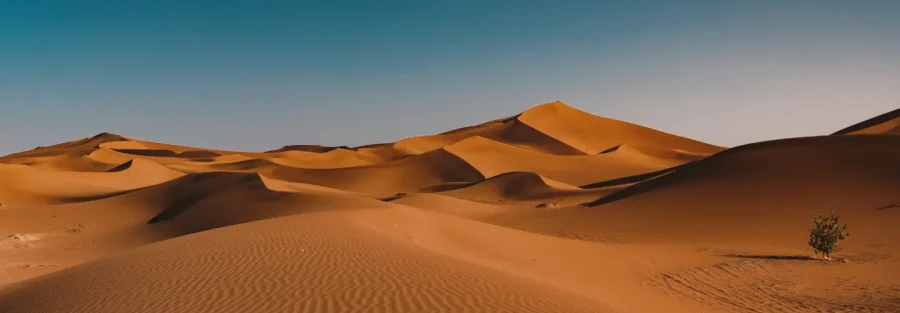
The world is running out of sand. This is not a metaphor. Riverbeds are disappearing, coastlines are collapsing, and the material that holds modern civilization together is becoming genuinely scarce. Somewhere in the Gulf, buried under several trillion tones of the stuff, a procurement officer is placing an order for more.
The Rule That Should Not Need Stating
There is a rule in the universe, or something close enough to a rule that it might as well be one, which states: if you are surrounded by something, you cannot run out of t. The rule is simple enough that it barely needs stating. It belongs in the category of facts so obvious they are never written down, the category that includes observations like fire is hot and water flows downhill and the desert has sand. The Gulf has always known this about itself.
The sand is not incidental to the Gulf. It is the Gulf. It is in architecture and mythology and the light at four in the afternoon when the sky turns the color of something that has been burning for a very long time.
You cannot separate the Gulf from its sand any more than you can separate the sand from its own fine, smooth, wind-polished grains.
Which is, it turns out, precisely the problem.
The sand of the Arabian desert is too fine. It has been sitting in the sun for millions of years, worn smooth by wind until every grain is a near-perfect sphere, round and polished and aerodynamically ideal and almost entirely useless for construction. Concrete needs sand with angular edges, sand that grips and locks and holds its shape under pressure. Desert sand slides. Desert sand will not bind. You can be surrounded by the largest continuous sand desert on the planet and have, in the technical and commercially relevant sense of the word, no sand at all.
So, the Gulf imports it. From Australia. From India. From countries with rivers, and riverbeds, and the kind of coarse, angular, geologically useful sand that gets ground into shape by water rather than wind. The UAE spent over three billion dollars on imported sand in a single recent year. Saudi Arabia, building NEOM and the Red Sea Project and a hundred other monuments to the proposition that the future can be constructed wholesale from ambition and procurement, is one of Australia’s most reliable sand customers. Qatar built its World Cup stadiums partly from sand shipped in from other countries: imported into a peninsula that is itself made almost entirely of the wrong kind of sand.
$3B+ Spent on imported sand by the UAE in a single year, while sitting on one of the largest sand deserts on earth. The desert sand is the wrong kind.
Meanwhile, the World Is Running Out
Simultaneously, the world is running out of sand. This is not a metaphor and not an exaggeration. The United Nations Environment Program has documented it in detail. Humanity extracts approximately fifty billion tones of sand per year, making it the most consumed natural resource on earth after water, and extraction is outpacing the rate at which rivers and coastlines can regenerate it.
In Cambodia, illegal dredging has caused entire islands to disappear. In Vietnam, riverbeds have dropped so far that saltwater is intruding into farmland. In Sierra Leone, coastal villages have been swallowed by the sea because the sand holding the shoreline in place was taken and shipped to Singapore, which has used imported sand to expand its own landmass by nearly a quarter over the past fifty years.
Singapore is, incidentally, a very small island nation that ran out of space. It solved this by importing sand from neighboring countries to physically extend its territory into the sea. It did this so aggressively that Indonesia, Malaysia, Cambodia, and Vietnam have all, at various points, banned sand exports to Singapore specifically. Singapore found new suppliers. The island that had no room is eating the coastlines of countries that did.
This runs parallel to the Gulf story in a way that is hard to ignore. The world is not running out of sand. It is running out of sand in the right places in the right form. There is plenty of sand. There is an ocean of it under the Gulf. There is a growing global crisis about a shortage of the specific variety that is not there.
We built a civilization that depends on a single material, found a way to have enormous quantities of the wrong version of it, and called the resulting situation a supply chain problem.
The Ship Passing the Desert
In 2023, a cargo ship docked at Jebel Ali port in Dubai carrying several thousand tones of construction-grade sand from Australia. The journey took approximately twenty-two days. The ship passed, on its way, the edge of the Rub’ al Khali, the Empty Quarter, the largest continuous sand desert on earth: 650,000 square kilometers of sand so deep in places that it has never been measured to its base. The sand on the ship was worth considerably more per ton than the sand visible from the deck. The ship did not stop. It was carrying the useful kind.
Trade data: UN Comtrade, 2023 / Rub’ al Khali: USGS geological
What I keep returning to about this image is its completeness as an argument. You do not need to add anything. The ship passing the desert, carrying sand to the desert, because the desert’s sand is not the correct sand. It holds, in a single picture, everything worth saying about the relationship between abundance and usefulness, between having something and having it in the form you need, between the resources a place is given and the resources it requires to become what it wants to be.
The Gulf wanted to be cities. Towers and highways and airports with marble floors and indoor ski slopes and architecture that announces: we were desert and now we are not, or we are desert still but that is not the point anymore, the point is the skyline, and the skyline requires a different kind of sand than the one the desert has been producing for the last two million years. So, the desert imports sand. The logic is not broken. The logic is perfectly coherent, in the way that a sentence can be perfectly coherent and still be the funniest sentence you have ever read.
The Most Spectacular Wrong Hand
The Gulf states are, in aggregate, among the wealthiest places on earth in natural resources. They have oil in quantities that shaped the twentieth century. They have gas. They have sun in amounts so extreme that the UAE is now building solar installations large enough to be visible from orbit, which has its own quiet irony: using the most punishing feature of the environment to solve the energy problem the environment created. They have geography, the chokepoint of global shipping, the air corridor between East and West, the logistical fulcrum of a significant portion of world trade.
What they do not have, in quantities useful for the civilization they are building, is fresh water, arable land, stable topsoil, temperate climate, and construction-grade sand. They have been dealt the most spectacular possible hand of the wrong cards. And so, they buy the right cards. This is what Gulf Wealth, in its most fundamental operation, actually does: converts the one thing the ground provides in excess into every single thing the ground withheld entirely. The oil becomes sandy. The sand becomes the tower. The tower becomes the skyline that makes people forget the sand was imported, that the city they are standing in is made almost entirely of materials that had to be shipped across thousands of miles of ocean because the land beneath it did not contain them.
Every tower in Dubai is an argument. The argument is: we were here, in this impossible place, and we built anyway. What the argument omits is the shipment that arrived before the foundation was poured.
The skyline is the story the Gulf talks about itself. The supply chain is the story no skyline is designed to tell.
The Desert Is Still There
The sand crisis will not resolve itself. UNEP has been saying this with increasing urgency since 2014, and extraction rates have continued to climb because construction rates have continued to climb because cities continue to grow because people continue to move toward opportunity and opportunity continues to concentrate in places built with other people’s sand. The Gulf is both cause and casualty: a major importer contributing to the global shortage, building cities that will eventually require maintenance and expansion and therefore more imported sand in a market getting tighter every decade.
Researchers are working on ways to use desert sand in construction. There is genuine progress: certain concrete mixes can incorporate a percentage of fine sand if the aggregate ratios are adjusted. There is manufactured sand, ground from quarried rock. There are experiments with compacted desert sand as structural fill. None of it is quite there yet, not at the scale the Gulf needs, not with the specifications that skyscrapers require.
So the ships keep coming. From Australia, from India, from countries with rivers. They pass the desert on the way. They do not stop. The desert watches them arrive, as deserts do: silently, without urgency, across a timescale that makes the entire history of human construction look like a Tuesday afternoon. The sand underfoot has been there for millions of years. It will be there long after the last tower is built and the last import order placed and the last argument about what this place is made of has been settled by the desert itself, which has always known and never said.
The revelation is not that the Gulf imports sand. Once you understand the geology, the import is logical, defensible, necessary. The absurdity is what the situation reveals about building anything anywhere: that having the raw material is never the same as having what you need, that the world’s resources are distributed with complete indifference to where they are useful, and that civilization is, in its most basic operation, the project of moving things from where they are to where they are needed across distances that should make the whole enterprise look impossible. The Gulf just makes this visible in a way that is hard to ignore. It put the wrong sand on the surface, sourced the right sand from across an ocean, and built anyway. Every city on earth did something like this. The Gulf did it in the desert, in the heat, in fifty years, and made it look like destiny. The ship carrying sand to the desert is not a joke. It is the whole story of how humans build things, compressed into a single image so neat and so strange that it takes a moment to confirm it is real. It is real. The ship is still coming. The desert is still there. Neither of them finds this unusual.