


In early 2026, a routine excavation in Bahrain led to a discovery that has slowly begun to attract attention beyond academic circles. At first, it appeared to be a collection of fossilised remains. This is not unusual in itself. The region has a long geological history, and discoveries of ancient marine life and early land animals have been recorded before.
However, as researchers began to examine the structure more closely, certain details did not align easily with known classifications. What started as a standard find has now become a subject of quiet debate.
What Was Actually Found
The remains consist of fragmented bone structures embedded in sediment layers estimated to be several thousand years old. Initial observations suggest a large creature with an extended skeletal frame. What has drawn attention is the combination of features.
Some parts of the structure resemble known reptilian forms, particularly in the elongated spine and rib alignment. However, other elements appear less familiar. There are indications of extended joint structures that do not clearly match typical regional species.
Researchers have been careful with their wording. At this stage, the remains are being described as “unclassified” rather than unusual.
Why the discovery stands out
Bahrain’s geological record is relatively well studied compared to many neighbouring regions. Because of this, most fossil discoveries tend to fit within expected categories. This finding is different because it does not immediately fit into those patterns.
While it is too early to draw conclusions, the lack of clear classification has opened the door to broader discussion.
Where the “dragon” idea comes from
The word “dragon” did not come from scientists. It began appearing in local discussions and online forums shortly after early descriptions of the remains circulated.
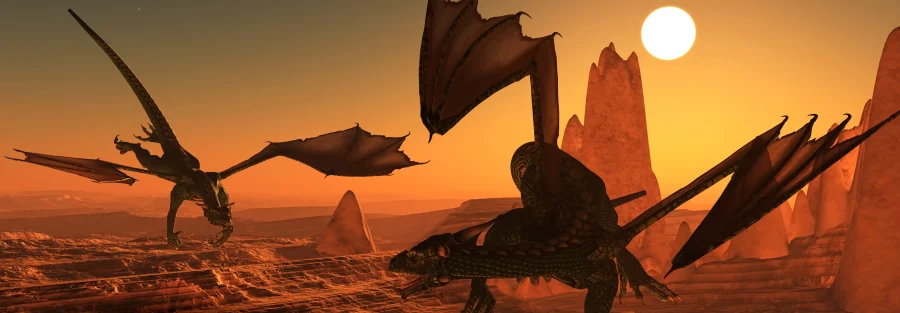
The idea is not based on a single feature, but rather on the combination of them. An elongated body, unusual joint structures, and what some describe as a wing like skeletal extension have led to comparisons with mythological creatures.
It is important to understand that no official source has used this term in a scientific context. However, the persistence of the comparison shows how strongly the structure has captured public imagination.
Why people are paying attention
Stories of dragon-like creatures exist across many cultures, including parts of the Middle East. These stories often describe large, reptile like beings with features that do not belong to any known animal today.
When a discovery appears that loosely reflects those descriptions, even in small ways, it naturally draws attention. At the same time, modern audiences are more exposed to science and research than ever before. This creates an interesting space where curiosity and skepticism exist together.
What Experts Are Saying
Researchers involved in the examination have taken a careful and measured position. Their focus remains on classification, dating, and comparison with known species. Early statements suggest that the remains may belong to a previously undocumented or rare species, rather than something entirely unknown to science.
This approach is expected. Scientific validation takes time, and conclusions are only drawn after detailed analysis.
The importance of evidence
At this stage, there are several unanswered questions.
- The full structure has not yet been recovered
- Dating analysis is still ongoing
- Comparative studies with known fossils are incomplete
Until these steps are completed, any definitive claim would be premature. This does not reduce the significance of the discovery. It simply places it within a process.
A Region Full of History
Bahrain’s history stretches back thousands of years, with layers of civilisation, trade, and settlement shaping its landscape. Because of this, discoveries in the region often carry both historical and geological importance.
While this particular find is being studied from a scientific perspective, it also adds to the broader sense of mystery that often surrounds ancient sites.
The Line Between Myth and Discovery
Throughout history, many scientific discoveries have initially sounded unlikely. Fossils of large prehistoric animals were once interpreted as evidence of mythical creatures. Over time, as understanding improved, these interpretations evolved into modern paleontology.
This does not mean every unusual find confirms ancient myths. However, it does show how easily observation and imagination can overlap in early stages.
Why this case feels different
What makes this discovery stand out is not just the structure itself, but the reaction to it.
There is a clear effort from researchers to remain grounded, while at the same time public curiosity continues to grow. This creates a gap between what is known and what is being imagined. That gap is where most of the conversation currently exists.
What Happens Next
The next phase of research will focus on:
- Completing excavation of the site
- Conducting detailed laboratory analysis
- Comparing findings with regional and global fossil records
These steps will take time. Results may confirm that the remains belong to a rare but known category, or they may introduce something less familiar.
Final Thoughts
The discovery in Bahrain is, at its core, a scientific event. Yet it has quickly become something more. It has sparked curiosity, speculation, and a sense of wonder that is not often seen in modern research stories.
Whether the remains turn out to be a rare species, a misidentified structure, or something entirely unexpected, one thing is already clear. Sometimes, even in a world driven by data and certainty, there are still findings that make people pause and ask questions that feel much older than science itself.
And for now, those questions remain open.